Capture trade-show contacts when the connection is unreliable
Konekt CRM · Research and examples prepared 7 November 2026
Prepare an approved local capture method before the event, give each conversation a stable reference and reconcile the notes after connectivity returns. A locally saved note is not yet a CRM record, and an attempted sync is not confirmation that the intended record arrived. Keep those states separate until someone checks the destination.
This guide is for a small sales team working at a venue where the connection may fail. It covers minimum useful capture, duplicate observations and recovery after interruption. It does not claim Konekt has an offline mode, that a badge scan supplies complete contact data or that exchanging a card grants permission for an automated campaign.
Choose the capture route while you still have a connection
Use a tool and device approved by your organisation. Decide what must be available locally, how access is controlled, where the working copy is stored and who will reconcile it. Do not discover during a live conversation that the form needs a network request before it can save.
Native offline CRM can be a suitable route if your actual product and device support it. Zoho's Android documentation, checked on 7 November 2026, describes working on locally stored records and synchronizing offline changes when connectivity returns. That is a documented alternative, not a tested Zoho installation or a description of Konekt.
A prepared offline document may also fit a small event. Google's desktop offline guidance describes setup for Docs and Sheets in supported browsers and a document-status check. It also identifies administrator and profile restrictions. A cloud document being visible online does not prove it is ready offline. Use the instructions for your actual device; the desktop guide does not certify a mobile capture route.
Rehearse the chosen method with fictional data. Disconnect the test device from the network, add a harmless entry, close and reopen the approved application, then reconnect and inspect the result. Record what actually survived. This article's author did not perform that device test; it is the acceptance work needed before relying on your chosen setup.
Capture the conversation rather than every possible field
Give the conversation a reference that works without the server, such as an event code, operator code and local sequence number. Its purpose is linking observations from the same conversation, not proving a person's identity. Two operators should not independently produce the same reference for unrelated meetings.
Capture the person's supplied name and company, the way they asked to continue, the subject discussed, the agreed next action and the operator. Record an email only if it was actually supplied or checked through your approved process. An uncertain spelling belongs in an uncertainty field, not a guessed contact address.
Distinguish observation time from later entry time, including the timezone if timing matters. Keep the person's words or a faithful short note separate from your interpretation. “Asked for the specification” is different from “ready to buy.” If the next action is to answer one question, do not turn it into a blanket sales sequence.
Collect no more than the approved purpose requires. A voice note, photographed card or badge export can add access, retention and handling questions. Choose that route deliberately. A local device copy needs the same care as other business data; being offline does not make it anonymous or temporary by default.
Reconcile six fictional observations into five conversations
The following records, people, business labels and actions are entirely invented. They are a local teaching fixture, not actual event leads, a badge scan or a CRM export. Any address-shaped value in the fixture uses a reserved example domain and must not be contacted.
| Observation | Supplied evidence | Proposed result |
|---|---|---|
| O01 · conversation C01 | Theo at Demo Fern asks for the specification through a supplied example address. | Candidate new record and one specification task. |
| O02 · conversation C01 | Same operator adds a later note: include installation dimensions. | Retain both observations under C01; one proposed next action. |
| O03 · conversation C02 | The case stipulates a confirmed existing-contact reference; the person asks about a current proposal. | Proposed existing-record note, not a new contact. |
| O04 · conversation C03 | A name is legible, but the supplied address is not. | Hold entry requiring that address; no guessed correction. |
| O05 · conversation C04 | The person explicitly declines follow-up. | No sales-follow-up task; preserve the handling decision under policy. |
| O06 · conversation C05 | A card is left at the stand without a recorded conversation or next action. | Hold purpose and routing; no invented request for a demo. |
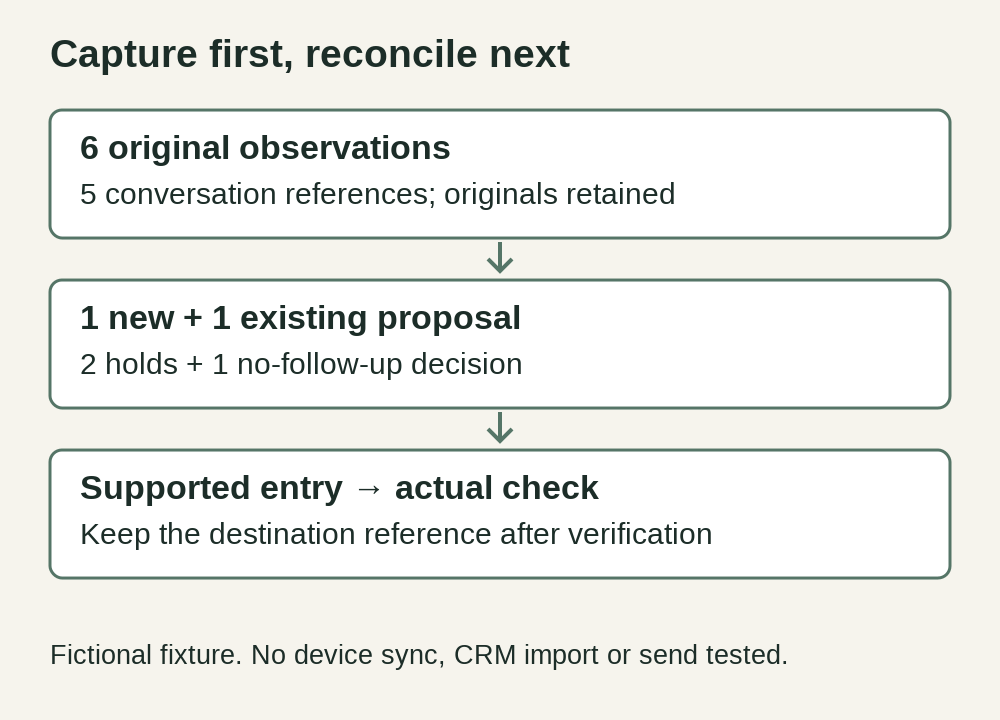
The output is one candidate new-contact action, one proposed existing-contact update, two holds and one no-follow-up decision: five conversation decisions in total. O01 and O02 remain two original observations. Linking them does not delete the first note or create a second person.
The existing-contact match in O03 is a supplied fact of this fiction. In real work, establish that match from appropriate identity evidence before updating a record. A shared company, familiar first name or matching stand visit time would not establish it by itself.
Use entry states that do not overstate progress
Use separate labels for captured locally, reviewed, entry requested and destination checked. Add the destination record reference only when it actually exists. An optimistic success message, a spinning indicator or the return of network coverage does not tell the next operator whether the intended record is complete.
For C01, the proposed record retains the original observations and one task covering the requested specification and dimensions. The operator should be able to trace that task back to the conversation. C02 stays associated with its confirmed existing reference so the entry person does not create another contact merely because the event file has a new row.
Download the fictional observations and proposed decisions to inspect the exact accounting. It is a small JSON teaching pack with no product-specific headers. The local check verifies six observation IDs, five conversation references and their stated partitions. It performs no mobile save, sync, import, deduplication or message send.
Resolve concurrent changes from the content, not only the time
Suppose the event operator records a follow-up date while a colleague changes the same opportunity online. The later timestamp does not automatically make one value correct: the notes may refer to different commitments or use different clocks. Preserve both, identify the underlying conversation and let the responsible owner resolve the next action.
Ask the supplier how its actual offline or import route handles an existing changed record. Does it show a conflict, overwrite selected fields, append a note or reject the update? Observe that behavior with approved fictional data. Do not write a generic “sync handles duplicates” rule into the operating process before establishing what the selected method does.
Keep corrections as additional evidence where possible. If O04's address is later confirmed, add the confirmation and source rather than silently replace the uncertain original. If the person never supplied a usable continuation route, the result can remain a hold. A complete event count is less useful than a trustworthy next action.
Recover after an uncertain save or interrupted sync
When a save is uncertain, first inspect the local record and its reference. Avoid repeatedly creating new entries with different IDs. On reconnection, inspect the destination for that reference or the supported identity relationship before retrying. A retry should be a deliberate recovery action, not the default response to a slow screen.
If the destination contains two records, preserve the evidence and follow its supported duplicate-review process. Do not delete one merely because its timestamp is older: it may contain a note absent from the other. Keep the reconciliation decision and any changed task ownership visible to the people who will follow up.
If the local record is missing and there is no destination copy, record the loss honestly. Do not reconstruct a buying request from a badge count or another operator's vague recollection. A colleague can help establish a factual note, but any remaining uncertainty should survive into the handover.
Choose a simpler route when synchronization adds no value
For a handful of approved conversations, a secure local note and careful later manual entry may be sufficient. The important result is a checked destination and an owned next action. Purchasing an offline CRM solely to avoid a few entries can add another device and synchronization boundary without solving a meaningful volume problem.
For a larger event or several operators, the opposite may be true: manual reconciliation can become a material burden. Use the rehearsal to measure the actual work and failure points. The six-row fiction supplies no capture speed, error rate or lead-to-sale prediction.
Bring the unsupported boundary to the product evaluation
When evaluating Konekt, ask how your intended entry method accepts the reviewed records and preserves references, notes and existing relationships. If offline work is essential, require a demonstration of the actual supported device and route; this article establishes no Konekt offline capability.
The existing CRM pilot helps test the online receiving job after the capture method is established. Review Konekt's current product offer for the setup that passes those tasks. Keep held conversations outside follow-up until their missing facts are resolved. Neither more prospect data nor another subscription can supply a conversation that was never recorded.